Taiwan Proteomics Society, an organization affiliated with HUPO
Taiwan Proteomic Society (TPS) was established in 2003. Andrew H.-J. Wang,
currently the vice president of Academia Sinica, Taiwan, organized the very
first society member meeting in Taipei. Approximately 40 founding members
participated in the first meeting. The main focus of the meeting was to promote
awareness of emerging proteomics research to the scientific communities in
Taiwan and to create educational infrastructure for college-level students in
learning basic knowledge in proteomics. The meeting was successfully echoed by
his colleagues and Ministry of Education, resulting proteomics courses taught in
many universities and a textbook published in Chinese on proteomics prepared by
a cooperative effort from scientists in Taiwan. During May 15th-17th in 2004,
TPS hosted its first conference, 3rd International Proteomics Conference 2004
(IPC’03), 1st Taiwan Proteomics Conference, Joint Meeting of AOHUPO 2004 (1).
The conference was a joint meeting organized by TPS and Asia Oceania HUPO (AOHUPO).
Interestingly, the conference was held in 2004 yet termed as IPC’03 because it
was supposed to happen in 2003 but delayed due to severe acute respiratory
syndrome (SARS) outbreak in southestern asia.
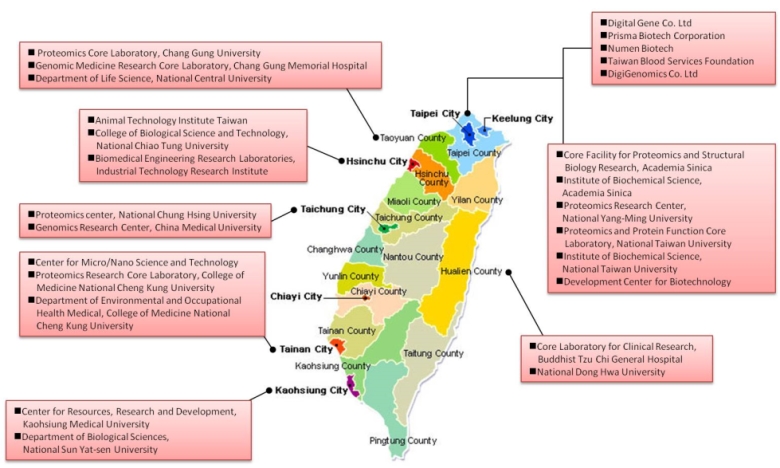
In the past five years, there has been a rapid development of proteomic sciences
in Taiwan. Sixteen research institutes and universities now implemented
proteomic facilities (see Figure 1 for their geological locations) all with
capability and capacity in offering services such as two-dimensional gel
electrophoresis and protein identification by mass spectrometry. A major
investment at national academy of Taiwan, Academia Sinica, was funded by Core
Facilities for the National Research Program for Genomic Medicine (NRPGM),
National Science Council (NSC) Taiwan, equipped the participants of the NRPGM
projects state-of-the-art instrumentation required for modern proteomics
research activities. NSC has been the largest funding agency for scientific
research in Taiwan and sponsored by the government. NRPGM was launched since
2001 as a national priority program to allocate research resources in the field
of genomic medicine in Taiwan. Another notable proteomics facility is invested
by Industrial Technology Research Institute (ITRI) in Hsinchu City, a non-profit
R&D organization engaging in applied research and technical service in Taiwan.
The high-throughput protein analysis facility now supports ITRI’s intramural
projects focusing on stem cell differentiation and liver tissue development.
In 2007, there were two major conferences sponsored by the TPS. One was held at
National Chung Hsing University (NCHU) in Taichung as a local activity in the
central Taiwan with an emphasis on agricultural applications. The NCHU began as
an agricultural college 87 years ago, and is the most prominent educational
institution on agriculture in Taiwan. The other one was arranged with National
Cheng Kung University in Tainan as the official annual society meeting. The NCKU
is the largest state-run national university in the southern Taiwan and is
gearing for rapid growth in research capacity under a stimulant funding package
provided by the state administration, Promoting Academic Excellence & Developing
World Class Research Centers from the Ministry of Education. The conference,
Taiwan Proteomics Society International Conference 2007 (TPSIC 2007) was held
during December 4 th-6 th with a record-high number of registered participants -
more than 400 domestic attendee from various scientific disciplines and 8
renowned overseas scientists as invited speakers. They came to the ancient city
in Taiwan, Tainan, to discuss many aspects of proteomics – from mass
spectrometry-based techniques, proteome informatics, post-translational
modifications, glycomics, phosphoproteomics, and structural proteomics, to
biomarker discovery, clinical proteomics, and system biology. The number of
participants and depth of the conference themes were impressive, reflecting an
ever growing interest of this new technology and its wide applications in
biology, diseases, biotechnology, and agriculture.
Since 2007, TPS decided to host two scientific meetings every year to promote
proteomics in this small yet highly populated island country. “Scientific
meetings and education, in addition to capital investment, are keys to the
future growth of proteomics in Taiwan” viewed by Shui-Tein Chen, the President
of Taiwan Proteomics Society. The leadership and dedication of Dr. Shui-Tein
Chen, as well as contributions made by all colleagues of TPS, have cultivated
the grand success of this organization. This year (2008), the first meeting will
take place in June at Tzu Chi University in the eastern side of Taiwan Island.
The second meeting, Frontiers in Protein PTMomics, will be held at Academia
Sinica in Taipei and co-sponsored by Taiwan-Japan Bilateral Technology
Interchange Project.
TPS now has 500+ registered members – a remarkable 10-fold growth in its
membership since its foundation in 2003. The number of publications related to
proteomics contributed from Taiwanese scientists is also growing. A survey
completed in May of 2008 for their publications in the three prestigious
journals, Molecular & Cellular Proteomics, Journal of Proteome Research, and
Proteomics (including Proteomics-Clinical Applications), indicated that
Taiwanese scientists have involved with 108 articles published in these
journals. Among the 108 articles, two thirds of them were published in the last
2.5 years. Witnessing the activities intrigued by TPS in pace with those by HUPO,
most scientists in Taiwan are now very much optimistic with their future
opportunities in proteomics sciences. Beginning with a small meeting in 2003,
TPS has so far made its significant impact to Taiwanese for embracing the
rapidly evolving proteomics technology.
Geological locations of universities and research institutions equipped with proteomics facilities in Taiwan
(Article from:Liao, P.-C.*, Wang, A. H.-J., Chen, S.-T. (2008) Taiwan proteomics society: an organization affiliated with HUPO. Molecular & Cellular Proteomics 7, 1584-1585.)









 History